Staff and friends blog. Contact us if you like to join!

Staff and friends blog. Contact us if you like to join!
Anna Davour blog about Science Fiction and other strange flavours of fiction.

Helena – "Seventeen, clumsy and shy, I went to England and found not love nor luck but something far, far better."

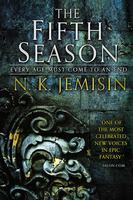 The world is ending. It has ended before, and it will end again. In N.K. Jemisin’s sixth novel The Fifth Season, Father Earth himself is the enemy, rupturing the world’s only continent through quakes, volcano eruptions, tsunamis and storms every couple of decades and sending its people into chaos as a result. The only thing standing between them and the wrath of the Earth are the orogenes, people born with the ability to connect with and draw power from the earth, but their power is feared and orogenes are hated and haunted across the continent. The story begins with yet another apocalypse – perhaps the most deadly one yet – and centers on three women: the child Damaya, the rising orogene Syenite, and Essun, an orogene trying to hide her powers – all of them at different stages in their lives, all of them facing the end of their world, in different places and different ways.
The Fifth Season is a clever book. Unlike much epic fantasy that puts the epicness in its worldbuilding with the help of a massive character gallery, Jemisin instead builds the scope and depth of her world through the weaving together of the three narrative threads and an ingeniously structured plot. It’s a slow build, but it doesn’t matter because The Fifth Season is an enjoyable read every step of the way. It is a fantasy novel that is not in the least interested in the upholding the status quo – how could that even be possible to do for long in a world that is continuously going under? – but rather about showing how fragile it can be, even as it holds people in an iron grip and is always reinventing itself. Stillness, the world Jemisin has created, holds no stone walls or traditions that has been standing strong for a thousand years. It is a world that requires change and adaptation and has little patience for nostalgia. It’s wonderfully done and gloriously refreshing (take note, fantasy authors!).
The Fifth Season is the first installment in The Broken Earth trilogy and while being an immensely enjoyable read in its own right, it also does great work as an introduction to the series that leaves me curious about where it will go in the following The Obelisk Gate. Partly because it ends on a cliffhanger, but mostly because Jemisin is currently doing real interesting stuff with the fantasy genre and it would be a shame to miss out on any of it.
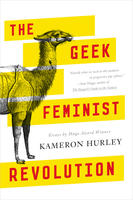 The Geek Feminist Revolution is an essay collection by science fiction and fantasy author Kameron Hurley about feminism, geek culture, narrative and writing. Dedicated to Joanna Russ, the collection is an oftentimes personal inquiry into the genres we, as feminists, both love and hate. Like Russ, Hurley believes in the transformative and subversive potential of science fiction and fantasy, and, like Russ, she also investigates and calls out its many uglier sides. Above all, the collection deals with responsibility. Narrative has effect, Hurley states – the stories we tell, the stories that we let dominate our cultural landscape, and the way we tell them do work on us, as readers, fans, and people. “Normal is a story,” Hurley writes. And stories can be rewritten.
Most of what Hurley writes about in The Geek Feminist Revolution is not new, not to people already invested in feminist, anti-racist and queer critiques of SFF and fandom, at least (which, obviously, is the audience for this book). That is not a knock on Hurley – she herself frequently stresses how the revolution she talks about is a longstanding group effort, if nothing else. Rather, the collection is a comprehensive guide to those kinds of critiques and discussions and the battles being waged over the politics of SFF (it’s there whether you want to admit it or not, Puppies!), delivered by Hurley’s colorful, rage-fuelled and entertaining rhetoric.
The collection includes essays on everything from the hijacking of the Hugo Awards, to Mad Max: Fury Road and True Detective, online harassment and Strong Female Characters, and much more. Some of the material in the collection has been previously published elsewhere, which becomes obvious since the conclusions of many of the essays are essentially the same: normal is a story that needs to be rewritten and reworked into something more sustainable. It is not a bad point to bring home and definitely one that bears repeating again and again, but taken together like this, it reads as slightly formulaic.
Among the new stuff, my favorite essay is probably “What’s So Scary About Strong Female Protagonists, Anyway?” where Hurley delivers a much-needed gut punch to the idea that what she calls the “post-Buffy” heroine who kicks ass in hotpants is ultimately empowering to (all) women or that the main problem with her is that she’s ‘too masculine.’ “Why to we celebrate ‘girl power’ but sneer at ‘women power’?” is a line that should be shouted from the rooftops. It’s far from the only gem in the book, too – The Geek Feminist Revolution is dangerously quotable. I kind of want to paper my walls with it.
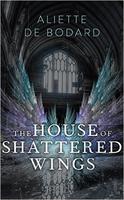 For some reason, fantasy dealing with Christian angel mythology and particularly Lucifer and fallen angels has always appealed to me as an idea, but it’s not often that any of it is actually good. Danielle Trussoni’s Angelology, Clive Barker’s The Scarlet Gospels and Andrew E. Maugham’s Convivium are all examples of novels dealing with those themes that are not necessarily bad but have left a lot to wish for. The House of Shattered Wings is not a perfect book, but when it comes to taking on angel mythology, Aliette de Bodard succeeds where most other authors seem to fail.
In The House of Shattered Wings, de Bodard envisions a postapocalyptic Paris in a Europe where fallen angels rule and have colonized most of the world and subsequently driven most other otherworldly forces underground. The once great city functions as a war-ridden stage for the political conflicts raging among the Houses of the Parisian nobility - with Houses Silverspires, Hawthorn, Lazarus, Harrier greatest among them. When House Silverspires was still led by Morningstar himself it reigned supreme, but in the long years after his disappearance it has began to fall into decline and it is eagerly hounded by the other Houses.
The new head Selene is doing her best to keep her House together but when she takes the newly fallen and wounded angel Isabelle under her protection and the unnervingly and oddly powerful human being in whose company Isabelle was found into custody, the already unsteady pillars propping up her House and rule begins to crumble. Something has been unleashed within the House – something dark and sinister that feeds on magic and lurks in the darkest shadows of the House and seems intent on sending Silverspires and all its inhabitants and dependents to ruin.
The board is thus certainly set for an intriguing story, but while it does have its flashes of brilliance, the plot sadly does little to make its wonderful, interesting and atmospheric worldbuilding of novel justice. It pretty much boils down to a simple whodunit story, which, sadly, is just not my piece of cake. The inter-House politics, the characters, and what glimpses the story provides of the rest of the world beyond Paris and Europe are all highly fascinating, but it is all held together by what in my opinion is a rather lackluster plot. It is a shame, because held together by a plot as engaging as its take on angel mythology and its atmospheric worldbuilding, The House of Shattered Wings would have been excellent rather than simply good.
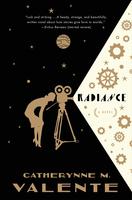 Catherynne M. Valente is well-known for her ambitious works of fantastical fiction and her latest novel Radiance may be her most ambitious yet. It is a hard book to review and even harder to describe, thanks to its multifaceted plot that keeps on turning in on itself in ever-intriguing twists and turns. Part noir mystery, part retrofuturism, and part movie-making fable, the story takes place between 1914 and 1962 in a parallel dimension where humankind has colonized and terraformed the entirety of our solar system – all the nine planets and most of their respective moons provide the wonderfully disturbing, colorful and glittering stage on which Radiance is set.
The worldbuilding of Radiance is incredible. There are many, many things about this novel that I love, but the worldbuilding is probably its absolute best part. Reminiscent of the Golden Age of science fiction, it joyfully renders a solar system where the Moon is an empire of film-making, Venus a paradise water-world and Pluto a deranged, otherworldly outlier on the edge of known space. It is the kind of science fictional worldbuilding that is based primarily on optimism, delight and awe, which is very rare these days, when the fields of speculative literature rather deals in pessimism and dystopia. That is not to say that there are no dark spots in Valente’s alternative universe, though, because they are certainly there – just because humanity has spread out among the stars doesn’t mean it has changed.
The story of Radiance centers on Severin Unck and her father Percival. They are both film-makers, but while Percival makes fantastical, whimsical pictures about things likes vampires and ice-dragons, Severin, as she grows up and into her own, instead chooses to make documentaries. As the final product of growing up with Percival and a long series of eccentric stepmothers, Severin is a fascinating character – even more so because she is largely absent for most of the book, existing only as a memory and a shadow hanging over its plot.
When on Venus filming what she thought would be her masterpiece, The Radiant Cars Thy Sparrows Drew, Severin disappears and several of her crew turns up dead. What actually happened is anyone’s guess – and guess people do. Radiance is a non-linear, motley narrative made up of logs from Severin’s many film projects, home videos from her childhood, interviews and editorials about her disappearance and whatever else goes on in the movie biz, debriefing sessions with her surviving crew, and excerpts from the movie her father is making about his daughter’s probable demise – And If She’s Not Gone, She Lives There Still.
Ultimately, I would say, Radiance is a story about endings. There is no definite ending to Severin’s story, but a definite ending is what her father is trying to create for her. “All the rest of the nonsense a story requires is just a long seduction of the ending,” as he himself puts it – endings is his own specialty. Radiance is a book full of stories lacking definite endings, because outside of fiction neat endings do not exist. And even within fiction the idea of a definite conclusion is often out of reach – fiction is by its very nature unbound by reality and therefore always open to trickery: slanting the artificial light just so is all needed to create, change or shatter the illusion of absolute truth.
As I said in the beginning of this review, Radiance is a hard novel to describe and write about, but – not unlike most of Valente’s other books – it’s also hard to do justice in a review, so I’ll just finish up by saying this: if you’ve read and liked Valente’s previous works, read Radiance. If you have never read Valente and is looking for a place to start, read Radiance. If you want a gorgeously written space opera noir mystery in a setting that hearkens back to the Golden Age of SF, read Radiance. So, in conclusion: read Radiance.

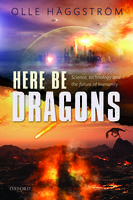 The title, "Here Be Dragons", refers to the uncharted territories of knowledge and technological abilities, where we might discover unknown threats. The mapmakers of old just hinted at possible dangers, but the message of this book is that we should do our best to prepare for situations where we might hold tools or knowledge that could destroy us.
You may have heard how famous scientists lately have written open letters and op-ed pieces with warnings about artificial intelligence or advice against sending signals to possible extraterrestrial intelligences. Are they serious? What are the risks, really, and how have these people come to be worried about such things?
If you want to dive into the current discourse about these possible threats to human existence, this could be the book to seek out. The mathematician Olle Häggström gives an introduction to the reasoning about some of these issues, and responds with his own arguments.
As the starting example Olle Häggström discusses the possible geoengineering techniques that might be employed to counter the global warming, and what risks would be associated with them. He then goes on to various schemes for improving humans, for example by extending our life spans, and what risks could be associated with that. Hostile artificial intelligences and rampant nanomachines also get their treatment, before Häggström goes on to deeper questions of the nature of science and probabilities. Two fairly abstract chapters with statistical arguments about expectations of the end of our civilisation are followed by a discussion about the search for space aliens. At the end, the author discusses some of the philosophy of how to weigh various future risk scenarios, balancing facts and moral values.
Here Be Dragons could perhaps be described as suitable for "advanced beginners". It seems to be intended mostly for fellow academics, but anyone who would like a more than superficial overview of what the various arguments look like could start with a chapter or two of this book.
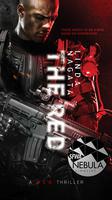 How much of your privacy would you give up to have superpowers? For Liutenant James Shelley it doesn't seem like he has a choice. He is monitored every single moment as long as he is in the army. He also seems to have a source of information that he cannot explain himself, something that makes him feel when there is some imminent danger.
The Red by Linda Nagata is the first book in a trilogy. On the cover it looks like a high-tech thriller, and it says clearly on the front that it is about war. It does deliver on these promises, but it is also a lot more. I found that the things that wanted me to read on and that stayed in my head after putting the book down were the problems surveillance and individuality in a hyperconnected environment. It's interesting to see how James Shelley navigates his existence and maintains relationships, being watched all the time – by his employers, but also in ways he could not foresee.
I should confess that I haven't read much of the kind of stories that might be labelled "Military SF", and even less that I have really liked. It's difficult not to compare The Red to The Forever War by Joe Haldeman. The books are in some ways very different, but they also have some things in common, for example the criticism of war and of the role of media.
In The Forever War the soldiers are used in a propaganda machine, where television airs synthesized interviews where the soldiers seem to say completely different things than they really told the journalists. In The Red the corresponding media exploitation is much subtler and the agenda much more difficult to identify. Recordings from surveillance cameras and from the equipment the soldiers are carrying edited and videos are shared virally on the internet ("the cloud"). But who is behind this, and why?
The war, then. The first thing James Shelley does in this book is to tell his linked combat squad what he thinks is the reason for war -- it is all arranged by the defense contractors, who need wars to make money. The leaders of these companies are known as dragons. They are really powerful and for the most part the life of normal soldiers are very far away from them.
Of course, Shelley is not exactly an ordinary soldier anymore.
The cyborg existence is another interesting part of this story. The way it is described really made me think about what constitutes a person, and how fluid the boundary is between external tools and parts of the body.
But don't worry, this is not only a smart and intellectually interesting book, there is plenty of action and mystery as well. And relationships, even a love story. I think this book would appeal to a much wider readership than just those who are attracted by it's cover.
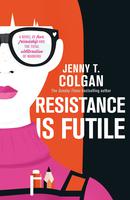 When Dr Connie MacAdair is offered a post-doc fellowship at Cambridge University promising two years of uninterrupted time to focus solely on her own research, sans teaching, she simply cannot turn it down. It almost seems too good to be true and, as it turns out, it is. Once she arrives, she realises that she has been placed in a bunker-like compound with five other mathematicians and, once she has signed a sinister confidentiality agreement, given a long sequence of numbers they’re expected to search for any viable patterns. To begin with, it simply seems like lengthy and tedious work, but eventually they figure out that, whatever the sequence says, it seems to originate from somewhere in outer space. Earth has come into contact with extraterrestrial life and it’s up to them to figure out what the message holds.
Resistance Is Futile is classic chick-lit meeting a first contact SF story. Naturally it’s a love story, and, naturally, the love interest is alien. In that regard, Resistance Is Futile holds some similarities to Stephenie Meyers The Host (is truly the only sexy alien the fluid, silver-sheened water nymph alien?) but while Meyer spins a postapocalyptic alien invasion story, Colgan instead tells the story of a nerdy maths girl who happens to end up in the midst of an intergalactic revolutionary conflict. In many ways, it is a great, fun and humourous novel, but ultimately, it’s just not my cup of tea, I have to admit. There are many individual things about the book I really liked, but the love story never really managed to get me particularly engaged and the overall plot come across a bit clunky, in my opinion.
While I thoroughly enjoyed the humorous tone of the novel, I think it suffers from a problem that commonly surfaces when non-SFF authors turn to the genres of speculative fiction: while the texts are not necessarily bad or uninteresting, it often tells a story and deals with themes and tropes that previously has been more successfully explored elsewhere. Instead of adding anything new to the conversation, it simply rehashes familiar ideas in often uninspiring ways. I wouldn't say it's a point directly against Colgan's novel, however - as I’ve said, I'm really not much of a chick-lit reader and as a result this novel simply didn't work for me. However, I'm certain that for anyone who does enjoy chick lit, nerdiness, maths, and/or aliens, Resistance Is Futile is a perfect fit.
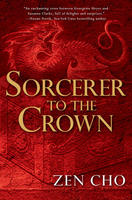 Sorcerer to the Crown by Zen Cho is a difficult book to review, simply because it feels like whatever I write, it will eventually and unavoidably simply collapse into one long list of everything that I love about this novel. To start off and hopefully get it out of the way: Sorcerer to the Crown is a highly atmospheric, beautifully written and wonderfully humorous novel.
Cho has created a parallel version of 19th century England where magic flows into the country through the border to Fairy and has become an area of occupation and study for upperclass men. White men, naturally, since they, it is believed, are the only ones with the prelediction to handle it. One of the novel’s two protagonists is Zacharias Wythe who, as a child, was purchased by Sir Stephen, the Sorcerer Royal, to be brought up and taught thaumaturgy to be the example that disputes the fact that magic is solely the domain of white men. As a result, Zacharias has spent his entire life battling prejudice and discrimination, which only intensifies when he, after Stephen’s mysterious death, becomes the Sorcerer Royal to the chagrin of the British magical elite.
One thing I think Cho handles very well in the novel is the relationships between Zacharias and the people of the world he has rather forcefully been brought into - particularly when it comes to those with whom he has loving or friendly relationships. While Zacharias holds deep affection for Stephen and his wife, he is simultaneously very conflicted by the fact that they basically ripped him away from his parents and paraded him around the Magical Society in England as some sort of circus show. This aspect of the novel also becomes apparent in the way Zacharias is treated by those who love him - most succinctly and painfully exemplified perhaps by the nurse who cared for him deeply, but at the same time encouraged him to be extremely nice and polite towards his adopted parents because she surmised it would be harder for them to love a black child. Cho skilfully portrays the power imbalance and heavily ingrained racism that remains very much in effect within these social configurations and the complexity with which it operates within them and how Zacharias is forced to deal with it on a daily basis without making it the extent of his story or development.
This also holds true for the novel’s second protagonist - the young woman Prunella who was taken from India as a child by her white father who quickly died afterward and left her in the care of a mistress for a school teaching gentlewomen with an unfortunate knack for magic to suppress their abilities. She has been taught her entire life to be grateful that someone was kind enough to take care of her despite her “native” appearance and limited connections - a notion that she forcefully rebels against. While all of Cho’s main characters are interesting in their own ways, Prunella is definitely my favorite. I haven’t read any other reviews of Sorcerer to the Crown so far, but I wouldn’t be surprised if a few won’t refer to Prunella as a ‘Mary Sue’ - a moniker she would never be in danger of receiving if she had been a male character. She is strong-minded, endlessly pragmatic and hellbent on getting her way. She also most often do get her way - she is extremely powerful, in a myriad of ways: through magic, cunning and sheer bloody-minded determination.
Sorcerer to the Crown is a novel about triumphing against racist and sexist power structures and against those who would gladly capitalize on these for their own personal gain. It is a great fantasy read, particularly if you, like me, have a soft spot for critical discussions of race and gender, imaginative magical systems, subtle, well-written humour, and wonderfully wicked witches. "A witch is always appropriate whatever her attire" are certainly words to live by.
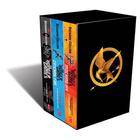
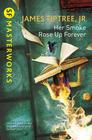
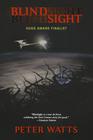
 I tend to find science fiction stories that deal with and, in some way or other, end in failure fascinating. A lot of speculative fiction deal with dark topics, pessimism, and dystopia - we are a long way from the optimism that was characteristic for what’s now commonly referred to as the Golden Age of SF, after all - but while the bulk of these stories may not necessarily have a happy ending, they do not primarily deal with failure. When I think of stories that are about failure, I think of Joanna Russ’ We Who Are About To…, about Suzanne Collins’ The Hunger Games-trilogy, about the immensely pessimistic stories of James Tiptree Jr., the works of Peter Watts, and about Aurora.
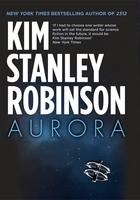
Aurora tells the story of a generational starship that has been travelling from Earth toward the Tau Ceti system for, at the start of the novel, approximately 160 years, with roughly ten more years to ago. The ship is an ark, transporting Terran species and ecological zones across the vastness of space to settle on a new planet and build a new world. But the ship is also a small closed system that demands constant and vigilant care in order to remain healthy and, in return, keep its interior and human population alive and well long enough to reach its destination.
Aurora is a story about the consequences and limitations of interstellar travel and the dream of leaving Earth and branching out among the stars. The novel portrays a future of splendid technological advances and possibilities, but ultimately focuses on what’s not possible, on the the limitations of human nature that we may never be able to engineer our way out of; maybe Earth is not humanity’s cradle, but rather it’s only viable home. This does not mean that Aurora is a cautionary fable bemoaning the dangers of technology, however, because it’s definitely not - it is simply not interested in a success story, but it instead in one of failure, and that is what makes the novel such an engrossing and fascinating read.
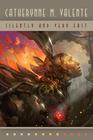
Furthermore, the story of this foray into deep space is told from the perspective of the starship’s A.I., which is slowly, at the insistence of its head engineer Devi, teaching itself how to tell a story and, in the process, develop something akin to human intelligence. It is a motif that has been explored elsewhere - for example in Catherynne M. Valente’s astounding Silently and Very Fast - but that makes it no less interesting to follow the A.I.’s struggle to form a narrative account of its travel and how its programming responds and develops from it, and how that eventually affects the entirety of the ship and its populace.
Having a non-humanity entity with, at least at first, little to no sense of narrative structure also makes for an interesting rendering of the day to day business of keeping the ship and all its parts working. While the story certainly has its dramatic peaks, it first and foremost manages to give the sense that the journey is one of endless, daily grind, where the main danger may not be one major catastrophic event, but rather many small problems that crop up and eventually accumulate. Overall, Stanley Robinson has done a great job of capturing the inner workings of the starship (even though he seems to almost deliberately shy away from certain questions regarding gender and sexuality in a way that seems strange, given the amount of detail that has gone into basically everything else concerning the life of the ship and its human population). Aurora is my first foray into his bibliography, but I’m sure it won’t be my last.
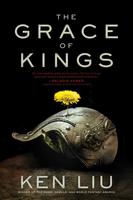 The Grace of Kings, short story writer Ken Liu’s debut novel, is epic in every sense of the word. Clocking in on just over 600 pages, the tome holds a story of massive scope. It begins with a failed assassination attempt on the Emperor Mapidéré, former king of Xana, who has conquered all of the Dara states and united them all under one rule in an attempt to bring stability and safety to the realm. He may have succeeded in turning the many dissident states into one grand Empire, but in the end, the Emperor is led astray by his own greed and hunger for power and eventually his Empire dissolves into rebellion, war and upheaval.
The story stretches across several long years, mapping a seemingly never-ending game of blood, politics and power played out across the continent between kings, generals, politicians and rebels. Two men - the great warrior Mata, last heir of the noble Zyndu line, and Kuni Garu, a trickster and bandit who suddenly and unexpectedly finds himself the leader of a motley rebel force - join together in order to free the islands of its corrupt rulers, but in this world of bloody battles and trickster gods, high ideals are, in the end, seldom that easy to actually realise.
Ultimately, The Grace of Kings tells a story of power, the men that wield it, and it’s often disastrous, tragic results. During times of war, the power lies with the strongest warrior and the most skilled tactician, but there is little guarantee that those same men will fare as well in times of peace - quite the opposite, rather. Throughout the novel, men seize power and become leaders for many different reasons - an idealistic dream of a better future, greed, fear, pure luck, or a combination thereof - but whatever those reasons are, they all falter in some way or other when it comes down to actually realising their once lofty goals. The key conflict in the novel focuses not on the myriad battles, on and off the battlefield, that take place during its course, but rather on the question of what the building of a better world really costs. It may be easier to image a better future as downtrodden underdog than it is so actually bring it about once you have all that power in your hands, as the novel’s immensely large cast of characters all find out, sooner or later.
As I’ve already mentioned, The Grace of Kings truly does put the ‘epic’ in epic fantasy - a gigantic cast of (largely male) characters included. In many ways, the novel at the same time really manages to do something new with the genre - not only does it deviate from the standard “all fantasy world must be set in quasi-medieval Western societies!”-mold, but it also diverges from the grimdark way of storytelling where it seems as if the author providing the most detailed, up-close descriptions of all the blood, entrails and dirty mud their characters as to wade through in their various quests wins. That is not to say that Liu’s story isn’t a bloody and violent one, because it is, but it is instead told in a sort of folk-loric manner that I at first found almost annoyingly detached, but eventually grew to really enjoy. The novel shifts between vastly sweeping through characters and events and really digging down into the character’s personal lives and motivations in a way that makes for fast-paced read that’s not weighted down by unnecessary details or descriptive nonsense. There are no boring, lengthy lists of how people dress or what they eat, or drawn-out quests across the land to show off the worldbuilding - Liu brings his made-up world alive through different means, through the sheer enormity of its scope, the intricate weave of the story’s many-faceted intrigues, and the complicated motives of its characters.
Furthermore, Liu, especially in the latter half of the novel, lays forth in interesting discussion of gender politics. To begin with, female characters are, to put it mildly, scarce. Though disappointing, it somewhat brilliantly reflects the narrative arc of the plot - at first, under the rule of the Emperor, the continent is in some kind of peace; during the course of the story, however, not only the Empire but also much of its traditions and values are thrown into disarray. The warfare and political upheaval ultimately also allow for women, both as individuals and as a group, to somewhat rearrange their place in the world. However, at the end of the novel, where some sort of conclusion and a new state of peace seems to have been reached, the women, the ending suggests, revert back into their traditional roles as wives and mothers, left to plot and conspire in the shadows of their male relations - there is no longer any need for desperate measures, no room for women to easily step beyond their traditionally assigned roles. Order has been restored. It is very nicely and subtly done, but at the same time, the female characters unfortunately remain very few and far between.
It may not really be a minor complaint, but to be honest, it’s only one of few I had while reading The Grace of Kings - once I got beyond the 200 page mark, at least. The novel is a bit slow to pick up, but once it does, it’s well worth it. If you enjoy reading intricately plotted, well-written, epic fantasy (with an emphasis on the epic), look no further.
(security protocol currently unupdateable, but we don't ask for any personal info)
UPPSALA
Mon-Fri 10-18.30,
Sat 10-17,
Sun 12-17
STOCKHOLM
Mon-Fri 10.30-18,
Sat 11-17,
Sun 12-17
GÖTEBORG
Mon-Fri 10.30-18,
Sat 10-17.30,
Sun 12-16
UPPSALA
The Uppsala
English Bookshop
Svartbäcksgatan 19
753 32 Uppsala
Tel 018-10 05 10
uppsala@bookshop.se
STOCKHOLM
The English Bookshop
Södermannagatan 22
116 23 Stockholm
Tel 08-790 55 10
stockholm@bookshop.se
GÖTEBORG
The English Bookshop
Kungsgatan 19
411 19 Göteborg
Tel 031-45 55 10
goteborg@bookshop.se
You get 15 days free credit just for being nice...
You only pay the actual postage/freight for delivery.
No postage if you pick it up at a local bookshop.
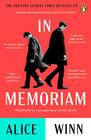
In 1914, war feels far away to Henry Gaunt and Sidney Ellwood. They’re too young to enlist, and anyway, Gaunt is fighting his own private battle – an all-consuming infatuation with the dreamy, poetic Ellwood – not having a clue that his best friend is in love with him, always has been. ”It was only because Gaunt knew he might die, that he could be so reckless as to kiss him.” An epic tale of the devastating tragedies of war and the forbidden romance that blooms in its grip. // Discuss in the Modern Fiction reading group //
Subscribe to the book-of-the-month!
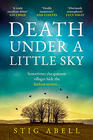
It’s a classic setting: big city detective moves to a small country village for some peace and quiet, not getting much of either as he has barely unpacked when the bones of a young woman are discovered. The quiet country life that Jake Jackson envisioned is no more. Sometimes the quietest villages hide the darkest secrets… // Discuss in the Crime reading group //
Subscribe to the book-of-the-month!
 Join our subscription Book Club and get a new book in the post every month. It’s like Christmas all year round! All picks are made personally by us in the bookshop. Choose your favourite category (or categories) and we’ll send you a new wonderful surprise each month.

 Join the Uppsala shop on Facebook
 Follow us on Twitter
 Follow our Instagram
 Our videos on YouTube
 RSS Feed News